Chain maille is one of the oldest and most fascinating forms of metalwork. Recognized for its intricate patterns of interlocking metal rings, it has served many purposes throughout history, from protecting warriors on the battlefield to becoming a distinctive form of jewelry and wearable art.
Today, chain maille brings together history, craftsmanship, creativity, and personal style. Whether it appears as a traditional chain shirt, an elegant necklace, a bracelet, or a pair of handcrafted earrings, the fundamental principle remains the same: individual rings are connected to form a larger, flexible structure that is both functional and beautiful.
For those discovering chain maille for the first time, understanding its history and practical uses offers a deeper appreciation for the artistry behind every piece.
What Is Chain Maille?
Chain maille, also commonly spelled chainmail, is a form of metalwork created by linking small metal rings together in a repeating pattern. The French word maille refers to a mesh or network, an apt description of the connected rings that make up the finished piece.
Unlike a solid sheet of metal, chain maille consists of many individual links. Depending on the ring size, metal, thickness, and weave, the resulting structure can be lightweight and flexible or dense and substantial.
The rings may be connected using different techniques. Some are formed from wire and left open before being linked together and closed, while others may be riveted or welded, depending on the intended purpose and historical tradition.
The particular arrangement of the rings is called a weave. Different weaves create distinctive appearances, textures, degrees of flexibility, and structural properties.
This versatility is one reason chain maille has remained relevant for centuries. The same basic concept can produce protective armor, practical mesh, decorative objects, and intricate contemporary jewelry.
The History of Chain Maille
The history of chain maille stretches back more than two thousand years. Archaeological evidence shows that interlinked-ring armor was being made in Europe by approximately the third century BCE, although the precise origins of the technique remain debated. The craft is often associated with Celtic peoples, but its development cannot be attributed with certainty to one inventor or culture.
As metalworking skills improved, mail armor became an important part of military equipment across Europe and eventually appeared in many other regions, including parts of Asia, the Middle East, and North Africa. Craftspeople produced garments by connecting thousands of small rings, a process that required considerable time, skill, and labor.
During the medieval period, chain maille became especially associated with knights and soldiers. A mail shirt, often called a hauberk, could cover the torso and extend down the arms, offering protection while allowing greater freedom of movement than many rigid forms of armor.
Mail was not limited to shirts. Historical examples include coifs to protect the head and neck, gloves, sleeves, collars, and protective sections designed to cover vulnerable areas around the joints. These pieces could be worn with padded garments and, later, combined with plate armor to protect areas that solid metal plates could not easily cover.
As plate armor became increasingly sophisticated, chain maille did not simply disappear. It continued to serve as supplementary protection, particularly where flexibility was important. Mail garments and components remained in use in some military traditions well after their prominence in European warfare had declined.
The historical legacy of chain maille is therefore not just one of battle and defense. It is also a story of technical ingenuity: how generations of craftspeople developed a practical material from thousands of small, interconnected parts.
The Original Purpose: Protection and Flexibility
The primary historical purpose of chain maille was to protect the wearer from injury during combat.
Its design offered several advantages:
- Protection against cuts: Interlinked metal rings formed a barrier that could help resist slashing weapons.
- Flexibility: Unlike a rigid metal plate, mail could bend and move with the body.
- Coverage: It could be fashioned into garments and shaped to cover areas such as the torso, arms, neck, and joints.
- Compatibility with other armor: Mail could be combined with padded clothing and plate armor to improve overall protection.
However, chain maille was never impenetrable. Its effectiveness depended on the construction of the rings, the quality of the metalwork, the weapon involved, and whether the wearer had additional protective layers. Mail was generally more effective against cuts than against the concentrated force of a strong thrust or blunt impact.
These qualities explain why the basic structure remained useful for so long. Chain maille offered a combination of coverage and flexibility that was difficult to achieve with a single solid piece of metal.
How Chain Maille Is Made
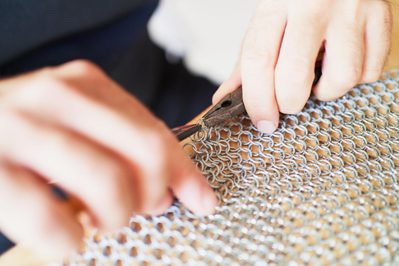
One of the most remarkable things about chain maille is the simplicity of its basic components. A finished piece may contain hundreds or thousands of individual rings, yet those rings work together to form a continuous pattern.
The process typically begins with metal wire, which is formed into rings. Depending on the design, the rings may be cut from a coil, prepared in different sizes, and finished before being assembled. The maker then connects the rings according to a chosen weave, carefully closing the links to create the desired pattern.
The craft requires patience and attention to detail. A ring that is improperly closed can affect the appearance, strength, or integrity of the finished work. Consistent ring sizes and careful assembly are particularly important when creating repeating patterns.
Understanding chain maille weaves
Different weaves give chain maille its distinctive character. Some produce a smooth, rounded chain, while others create a flatter surface or a more elaborate, sculptural pattern.
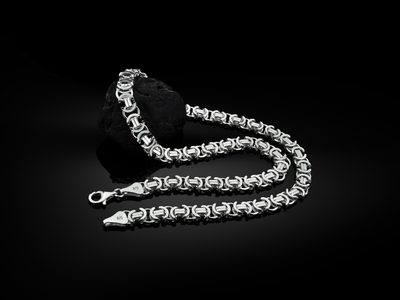
Byzantine weave
Known for its intricate, interlocking pattern and substantial appearance, Byzantine is a popular choice for necklaces and bracelets. Its repeating structure creates a rich texture that looks complex from every angle.
European weaves
European patterns, including European 4-in-1, create a flexible mesh by connecting each ring to several neighboring rings. This family of weaves is closely associated with traditional mail armor.
Japanese weaves
Many Japanese-inspired patterns arrange rings in structured geometric layouts, often using alternating ring sizes or contrasting metals to create distinctive visual effects.
Spiral and rope-style weaves
These designs produce flowing, rounded chains with a sense of movement. They work particularly well for jewelry that emphasizes the beauty and texture of the metal links.
These are only a few examples. There are many additional weaves, variations, and original combinations, giving chain maille artists an extensive range of creative possibilities.
The Many Modern Uses of Chain Maille
Although chain maille is widely recognized for its historical connection to knights and armor, its usefulness extends well beyond medieval history.
1. Jewelry and personal accessories
One of the most appealing modern applications of chain maille is jewelry making. Its combination of texture, flexibility, and metallic shine makes it suitable for a wide range of accessories.
Common examples include:
- Necklaces and pendants
- Bracelets and cuffs
- Earrings
- Rings
- Decorative chains and keychains
- Fashion accessories and ornamental pieces
Jewelry makers can work with different metals, finishes, colors, and ring sizes to create designs ranging from understated and elegant to bold and dramatic.
Silver-colored metals offer a classic appearance, while copper, brass, and colored aluminum can introduce warmth and visual contrast. Mixing metals can produce even more distinctive designs.
Unlike jewelry made from a single solid component, chain maille often invites closer inspection. The way each ring connects to its neighbors creates a repeating pattern that catches light differently as the piece moves.
2. Medieval reenactment and costume design
Chain maille continues to be popular among historical reenactors, Renaissance fair participants, theatrical costume designers, and fantasy enthusiasts.
Modern craftspeople create mail shirts, coifs, decorative collars, shoulder pieces, and other costume elements inspired by historical armor. Some are carefully researched reproductions, while others are imaginative interpretations designed for entertainment, display, or personal expression.
Chain maille also appears in films, stage productions, fantasy photography, and themed events, where its distinctive metallic appearance helps create a convincing historical or fantasy aesthetic.
Costume pieces should not automatically be considered protective armor. Their suitability depends on their construction and intended use.
3. Industrial and occupational applications
The same interlocking-ring principle has practical applications in certain industries.
Purpose-designed metal mesh and chain mail products are used in applications such as protective gloves for some meat-processing tasks, where cut resistance is important. Specialized protective products are also developed for particular industrial and occupational hazards.
These products are engineered for specific purposes and should not be confused with decorative chain maille jewelry or ordinary craft projects. Their protective performance depends on the materials, design, manufacturing standards, and intended application.
4. Art, sculpture, and decorative design
Chain maille is also a medium for artistic expression. Makers can create decorative panels, sculptural objects, hanging ornaments, costume embellishments, and textured metalwork.
By varying the ring diameter, wire thickness, finish, and weave, an artist can change the way a finished piece reflects light, drapes, or holds its shape.
Some designs emphasize symmetry and repeating geometry, while others use contrasting colors and unusual patterns to create a more contemporary appearance.
This flexibility allows chain maille to bridge the gap between traditional metalworking and modern craft.
Why Chain Maille Jewelry Is Special
There are countless types of jewelry available today, but chain maille has qualities that make it distinctive.
It combines tradition with creativity. The underlying technique has historical roots, yet contemporary makers continue to develop new designs and reinterpret traditional patterns.
It has remarkable texture. The interlocking rings create depth and visual interest that can be difficult to replicate with other jewelry-making techniques.
It offers variety. A small change in ring size, metal finish, or weave can produce a noticeably different result.
It celebrates the maker’s skill. Many designs require numerous individual assembly steps, making patience and precision essential to the finished piece.
It is versatile. Chain maille can be delicate or bold, understated or elaborate, traditional or contemporary.
For jewelry enthusiasts, these qualities make chain maille more than a decorative accessory. Each piece represents a particular arrangement of materials, patterns, and craftsmanship.
Caring for Chain Maille Jewelry
The best way to care for chain maille depends on the materials used. Stainless steel, sterling silver, copper, brass, and aluminum all have different characteristics and cleaning requirements.
As a general rule, store jewelry in a dry place and avoid unnecessary exposure to chemicals, perfumes, and moisture. Use a cleaning method appropriate for the specific metal, and take care with delicate components, gemstones, clasps, and decorative finishes.
Some metals naturally tarnish or develop a patina over time. This is not necessarily a defect; it is a characteristic of the material. If a piece includes multiple metals or gemstones, follow the maker’s care instructions rather than applying a universal cleaning method.
Proper care helps preserve the appearance of chain maille and allows its intricate details to remain a prominent part of the design.
Chain Maille: A Craft That Continues to Evolve
From its early role in protective armor to its place in contemporary jewelry, chain maille demonstrates how a practical idea can develop into an enduring art form.
Its history reflects the ingenuity of metalworkers who learned to turn individual rings into flexible protective garments. Its modern applications demonstrate the continuing usefulness of interlocking metal structures. And its place in jewelry making shows how a technique once associated primarily with armor can become an expression of personal style.
The next time you see a chain maille necklace, bracelet, or pair of earrings, take a closer look at the individual rings. Each one is part of a larger design, and the beauty of the finished piece comes from the way those individual elements work together.
Discover the Art of Chain Maille at Chain Maille By Fern
At Chain Maille By Fern, the intricate beauty of interlocking rings provides inspiration for distinctive jewelry and accessories. Whether you appreciate the historical background of the craft, the complexity of its weaves, or simply the appearance of beautifully arranged metal links, chain maille offers something worth exploring.
Browse the collection, discover different styles, and find a piece that reflects your own taste and appreciation for artisan design.
Explore Chain Maille By Fern and discover the beauty of a craft built one ring at a time.
There are countless types of jewelry available today, but chain maille has qualities that make it distinctive.
It combines tradition with creativity. The underlying technique has historical roots, yet contemporary makers continue to develop new designs and reinterpret traditional patterns.
It has remarkable texture. The interlocking rings create depth and visual interest that can be difficult to replicate with other jewelry-making techniques.
It offers variety. A small change in ring size, metal finish, or weave can produce a noticeably different result.
It celebrates the maker’s skill. Many designs require numerous individual assembly steps, making patience and precision essential to the finished piece.
It is versatile. Chain maille can be delicate or bold, understated or elaborate, traditional or contemporary.
For jewelry enthusiasts, these qualities make chain maille more than a decorative accessory. Each piece represents a particular arrangement of materials, patterns, and craftsmanship.
Caring for Chain Maille Jewelry
The best way to care for chain maille depends on the materials used. Stainless steel, sterling silver, copper, brass, and aluminum all have different characteristics and cleaning requirements.
As a general rule, store jewelry in a dry place and avoid unnecessary exposure to chemicals, perfumes, and moisture. Use a cleaning method appropriate for the specific metal, and take care with delicate components, gemstones, clasps, and decorative finishes.
Some metals naturally tarnish or develop a patina over time. This is not necessarily a defect; it is a characteristic of the material. If a piece includes multiple metals or gemstones, follow the maker’s care instructions rather than applying a universal cleaning method.
Proper care helps preserve the appearance of chain maille and allows its intricate details to remain a prominent part of the design.
Chain Maille: A Craft That Continues to Evolve
From its early role in protective armor to its place in contemporary jewelry, chain maille demonstrates how a practical idea can develop into an enduring art form.
Its history reflects the ingenuity of metalworkers who learned to turn individual rings into flexible protective garments. Its modern applications demonstrate the continuing usefulness of interlocking metal structures. And its place in jewelry making shows how a technique once associated primarily with armor can become an expression of personal style.
The next time you see a chain maille necklace, bracelet, or pair of earrings, take a closer look at the individual rings. Each one is part of a larger design, and the beauty of the finished piece comes from the way those individual elements work together.
Discover the Art of Chain Maille at Chain Maille By Fern
At Chain Maille By Fern, the intricate beauty of interlocking rings provides inspiration for distinctive jewelry and accessories. Whether you appreciate the historical background of the craft, the complexity of its weaves, or simply the appearance of beautifully arranged metal links, chain maille offers something worth exploring.
Browse the collection, discover different styles, and find a piece that reflects your own taste and appreciation for artisan design.
Explore Chain Maille By Fern and discover the beauty of a craft built one ring at a time.